
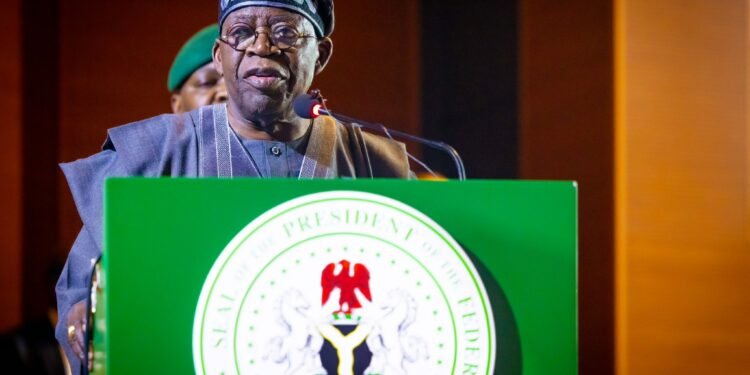
President Bola Tinubu has called for the establishment of an Africa-owned credit rating agency to counter what he described as the persistent mispricing of the continent’s risk by global financial markets.
The President made the call in an op-ed he published in the Financial Times on Monday, warning that African countries are paying excessively high borrowing costs due to flawed external assessments.
Tinubu argued that the so-called “Africa premium”, the gap between perceived and actual economic risk, is no longer sustainable.
He said the continent’s access to international capital is heavily influenced by the three dominant rating agencies, Fitch Ratings, Moody’s, and S&P Global Ratings, whose decisions shape investor behaviour but often fail to reflect local realities.
What the President is saying
According to Tinubu, only three African countries currently hold investment-grade ratings despite projections by the International Monetary Fund that Africa will be the world’s fastest-growing region this year.
He said this mismatch highlights structural flaws in how sovereign risk on the continent is evaluated.
The President cited a 2023 report by the United Nations Development Programme which estimated that rating “idiosyncrasies” cost Africa about $75 billion annually in higher interest payments and lost lending opportunities.
- “An African credit rating agency would address the greatest weakness of the “Big Three”: limited on-the-ground presence. In their models, quantitative data is weighed against subjective judgements on political risk, institutional strength and policy durability,” Tinubu argued.
- “How those judgements are reached — and how much they count — is left to opaque “analyst discretion”. Conclusions drawn from afar fail to capture local realities.
- “Relying on such judgements means global market cycles trump individual states’ economic fundamentals. Many countries across the continent have export-led economies based on commodities.
- “When prices fall or markets tighten, African nations are downgraded swiftly and broadly — even when their reserves are strong, fiscal buffers are intact and debt profiles remain manageable. Downgrades then become self-fulfilling, raising borrowing costs and straining public finances,” Tinubu added.
Nigeria reforms cited as evidence
Tinubu pointed to Nigeria’s recent economic reforms as proof that improved data transparency and policy adjustments can change investor perceptions.
He listed steps such as expanding the coverage and timeliness of economic statistics, incorporating previously off-balance-sheet central bank lending into official debt figures, rebasing GDP, and publishing more budget documents.
He also referenced policy decisions including fuel subsidy removal and exchange rate liberalisation, which he said have supported non-oil growth and reduced the naira’s dependence on global crude price movements.
- Despite these measures, Tinubu argued that Nigeria’s sovereign rating still lags behind reforms and market sentiment. He noted that the country’s dollar-denominated bonds issued in November were oversubscribed by 5.5 times, suggesting stronger investor confidence than reflected in formal ratings.
- Tinubu stressed that a new African agency should complement, not replace, the established global firms. While international investors will continue to rely on the Big Three for validation, he said a credible continental agency could detect improvements earlier and provide timely signals to markets.
- Delayed upgrades, he warned, impose real financial costs because countries that implement difficult reforms may wait years before gaining cheaper access to capital markets.
He noted that smaller African economies, which lack Nigeria’s scale and analyst coverage, are particularly vulnerable to such delays.
Flashback
Tinubu’s call for Africa’s rating agency follows a recent disagreement between one of the global rating agencies, Fitch Ratings, and Afreximbank.
Afreximbank in January this year officially terminated its credit rating relationship with Fitch, noting that the agency’s assessment no longer aligns with its establishment treaty, mission, or mandate.
- The fallout stems from Fitch’s June 2025 decision to downgrade Afreximbank’s long-term credit rating from BBB to BBB-, with a negative outlook — a move the bank contested strongly.
- The agency had cited concerns about Afreximbank’s sovereign loan exposures and asset quality, particularly as several African governments faced debt restructuring.
- Fitch’s downgrade was based on increased exposure to sovereign borrowers like Ghana, South Sudan, and Zambia, all of which were undergoing or at risk of debt restructuring.
- Fitch and the bank disagreed over how to classify non-performing loans (NPLs), with Fitch estimating NPLs at 7.1%, while Afreximbank reported 2.3%.
The agency raised concerns over transparency and the application of IFRS 9 accounting standards.
Fitch argued that Afreximbank’s participation in sovereign restructurings could weaken its preferred creditor status — a key factor in multilateral bank risk assessment.
Afreximbank firmly denied any involvement in sovereign restructurings, citing its treaty protections. It also defended its financial reporting, stating that its classifications are IFRS 9-compliant and supported by external audits.
What you should know
In June 2025, Group Chief Economist and Managing Director of Research and Trade Intelligence at Afreximbank, Dr Yemi Kale, had noted that flawed and externally-biased credit rating models are pushing up the cost of borrowing for African countries, despite their improving macroeconomic outlook.
According to Kale, international credit rating agencies continue to assess African economies using one-size-fits-all models that do not reflect the structure, risks, or policy frameworks within the continent.
Meanwhile, in the latest of the rancour between Fitch Ratings and Afreximbank, the rating agency downgraded the bank’s long-term credit rating from BBB- to BB+, effectively pushing the African multilateral lender into junk status.








Leave A Comment